Nonprofits and associations can easily use video to move donors and legislators to act, and, just as importantly, to feel. After all, why does video move you to act? It’s an emotional tie. It can be a child in need, puppy in an animal shelter, or a student striving for a college degree? Video can bring you just a little bit closer than the written world or even a still image. That closeness is what makes video effective.
People act when they understand what’s in it for them and when they feel emotionally connected to a story. In today’s crowded media environment, video has become the most effective tool nonprofits can use to clarify their mission, prove their impact, and motivate action from funders, policymakers, and the public.
Organizations that see real results from video don’t start with cameras. They start with clarity.
Strategic Clarity Starts with a Message Mapping Before the Camera Turns On
Before a single camera rolls, the most successful nonprofit video campaigns begin with a question directed to potential donors: “What’s in it for me?” In other words, from the viewer’s standpoint, what motivates them to keep watching, feeling and acting is driven by a sense of “What do they get out of it.” At Chemistry PR & Multimedia, we start our work with a structured Message Mapping Strategy Session, where we don’t jump into production, we dig into inquisitive questioning and listening first.
By the time we begin producing a video, everyone knows the story, the audience, the proof points, and how to express them. The video shoot becomes execution, not exploration. This methodology is rooted in message mapping and strategic alignment and allows our clients to create video that doesn’t just look good, but also acts as a catalyst for real results.
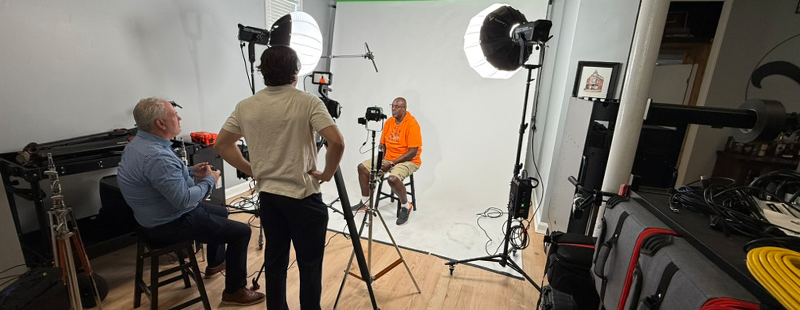
By using the organization’s board, staff, volunteers, donors and/or key stakeholders as interview subjects, there is a huge sense of pride in creating something greater than themselves. Rather than scripting everything, this method allows real voices and real emotion to lead the narrative.
A Documentary-Style Approach That Mimics Journalism Standards
One of the most effective ways nonprofits can use video to move donors and legislators is by adopting a journalistic, documentary-style storytelling model. Instead of relying on scripted narration, the story is built through:
- Authentic interview soundbites
- Natural storytelling arcs
- Purposeful pacing
- Visual storytelling through B-roll
In this format, audio leads and visuals support the message, which is the same standard used in professional newsrooms and documentary filmmaking. This creates trust, credibility, and emotional realism.
It also allows nervous or inexperienced on-camera participants to feel coached and supported, helping them deliver stronger, more natural soundbites when it matters most.
 Case Study: My Life In A Bag Foundation – Finding Focus That Leads to Action
A powerful example of how nonprofits can use video to move donors can be seen in the work completed for My Life In A Bag Foundation, an organization focused on improving the lives of children in foster care.
Before video production, the organization struggled with message clarity. The question, “What do you do?” elicited a 45 minute conversation. Much of this was simply passion for the organization, but there was definitely a need for clarity. Finding that “home base” message soon had us off and running to producing an effective video. The structured Message Mapping Strategy Session involving 12 key stakeholders — including board members, donors, volunteers, and founders, distilled their message into a clear, 15-second core narrative Home Base, supported by strong proof points.
The resulting 2 Minute video:
- Helped generate $8,000 in new sponsorships within two weeks of being shown to potential sponsors
- Became a central storytelling asset during their annual gala
- Emotionally moved audiences and motivated additional donations
- Brought founder Charles ‘Bizkitt’ Smith to tears when he first viewed the final version due to its emotional clarity and quality
The success of the video wasn’t about production alone, it was about message discipline, emotional storytelling, and trust built through authenticity.
Case Study: Missouri Forest Products Association – Educating Legislators at Scale
Another real-world demonstration of how nonprofits can use video to move legislators is the advocacy and education campaign created for the Missouri Forest Products Association (MFPA).
The challenge was systemic:
- No meaningful marketing for over 30 years
- Declining awareness of the industry
- Severe lack of knowledge among legislators about extremely relevant selling points:
- 42,000 industry jobs
- A $11 billion economic impact
- Forestry as the 3rd largest crop in Missouri
The solution was not a single video, it was an ecosystem of strategic content.
Approximately 70 educational and advocacy videos were produced and paired with:
- Targeted social media campaigns around Jefferson City and to supporters
- Strategic billboard placements along major highways leading into the Capitol
- Coordinated visibility during legislative travel windows
The results:
- More than 113 million impressions
- Increased awareness among legislators, the public, and the architecture and design community, which makes up a key base of potential customers
- A measurable shift in how forestry and wood products were discussed in policy conversations
This campaign demonstrated that video isn’t just a storytelling tool, it’s a visibility, education, and policy influence tool.
The video piece was key through all of this. It allowed the audience to see the work. (Note, when you have something visually interesting, get as much video out as possible!) It also introduced them to some of the people in the industry. Instead of a statistic, there was now a face and a voice.
Why High Production Value Builds Trust With Donors and Legislators
While authenticity is critical, production quality also plays a significant role in influence.
Nonprofits that want to move donors and legislators must be taken seriously. This means investing in quality. If you hire people skilled in videography and the type of storytelling that goes with it, you will go far. Pair those skills with high end tools (professional lighting and sound gear along with top-end cameras) you will go farther still
Higher production standards signal credibility legitimacy, and professionalism, especially when videos are used in legislative briefings, committee hearings, or funding conversations.
Quality production creates trust while authenticity drives emotion.
How Nonprofits and Associations Can Use Video to Move Legislators in Real-World Settings
Videos created for nonprofits are no longer just for websites or social media. Modern advocacy videos can be used in Legislative hearings, Policy briefings, Committee presentations, Grant reviews and Community forums.
When complex issues must be understood quickly, video becomes a visual executive summary that lawmakers actually watch and remember.
Short timelines, clear proof points, and strong emotional clarity make video one of the most effective policy education tools available.
Long-Term Advantages of Video as a Mission Asset
When organizations understand how nonprofits can use video to move donors and legislators, they stop treating video as a one-time project and begin viewing it as a long-term asset.
Strong nonprofit video campaigns can be reused across Fundraising initiatives, Sponsorship pitches, Advocacy efforts, Websites, as well as Social media and Events and galas. Video becomes a permanent part of their communications infrastructure.
People don’t respond to information, they respond to stories they feel. When nonprofits pair message clarity, emotional authenticity, journalistic storytelling standards, and high production value, video becomes more than content. It becomes a catalyst for real-world action. You can move a person emotionally, which then moves them to action.
To learn more about our Associations Communications, as well as, Nonprofit, Charity and foundation work, please contact us. you can also learn What We Do by clicking the link.