Is your construction company ready for a crisis? Crisis communications planning is no longer optional for companies operating in high-risk, high-visibility job-site environments. With heavy machinery, multiple contractors, public exposure, regulatory oversight, and unpredictable variables, construction companies face moments where a single incident can rapidly escalate into a safety, legal, and reputational emergency. Understanding strategies for construction crisis management and how leadership responds in those first critical moments often determines whether the situation is contained or compounded.
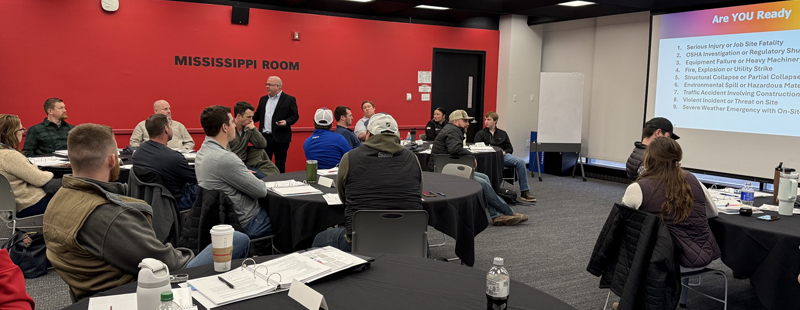
Last week, I was invited to guest lecture on Crisis Communications for the SIUE Construction Leadership Institute, a 9-week leadership development program attended by construction and job-site leaders from across the St. Louis region. Rather than relying on theory alone, the session placed participants into live crisis simulations with a reporter and cameraman, forcing participants to respond in real time under pressure.
The reason for this approach is simple. You never want to practice crisis communication during an actual crisis. Preparation allows leaders to slow down, think clearly, and respond with confidence. As Mike Tyson famously said, “Everyone has a plan until they’re punched in the face.” When leaders are prepared, the right response comes naturally. When they are not, instinct without basic knowledge often makes things worse.
Construction companies face a wide range of crisis scenarios, many of which unfold without warning and escalate quickly once cameras or regulators arrive. During the session, leaders worked through the most common crises construction firms encounter, including:
- Serious injury or job-site fatality
- OSHA investigation or regulatory shutdown
- Equipment failure or heavy machinery accident
- Fire, explosion, or utility strike (Gas/Electrical)
- Structural collapse or partial collapse
- Environmental spill or hazardous material release
- Traffic accident involving construction operations
- Violent incident or threat on site
- Severe weather emergency with direct on-site impact
- Community conflict or public opposition incident
Due to recent events, and in addition to the above ten scenarios, many construction leaders are now preparing for an 11th, increasingly sensitive situation: Immigration and Customs Enforcement (ICE) appearing on a job site. These incidents can involve ICE shutting down an entire project, detaining or arresting employees, or triggering protests that draw media attention and create overlapping safety, security, legal, and liability concerns. In these moments, the situation can shift rapidly from an internal issue to a highly visible public crisis.
Across all these scenarios, one truth remains constant. What leaders say in the first moments of a crisis often matters more than what they say later. Under stress, people tend to over-explain, speculate, or attempt to defend themselves. These natural reactions frequently create more damage than the incident itself.
That is why the session focused heavily on message mapping, a simple but powerful framework that keeps leaders grounded when emotions are high and facts are still developing. A strong message map gives leaders a clear statement about their business which rests at the center of everything you want people to know about you and your company’s intentions. We call it a “home base.” Every response should return to four core ideas: concern for people, what happened based only on confirmed facts, what is being done right now, and what will be done to prevent it from happening again. After that, leaders should stop talking.
In the first hour of a crisis, less is almost always more. A disciplined response may sound like this: “The safety and security of our employees is our number one concern. We are devastated by this accident, and we are cooperating fully with authorities to understand exactly how this happened.” Continuing to talk beyond that often increases risk rather than clarity.
One of the hardest things to say in a situation like this is, “I don’t know.” But if that is the case, you need to say so. Doubling down on information that you don’t actually have can be catastrophic.
When bad things happen, how a company responds reveals its values. Honesty builds credibility. Sympathy for those impacted must be genuine. Apologizing when appropriate shows accountability, not weakness. Leaders should not hide their emotions. Concern, seriousness, and empathy matter. Above all, doing the right thing must outweigh fear of headlines or discomfort.
At Chemistry PR & Multimedia, we often summarize this approach with a simple phrase: mess up, fess up, and dress up. Dressing it up does not mean spin. Dressing it up means reassuring employees and the public, explaining how leaders are fixing the issue, keeping people informed, and clearly showing that leadership cares It also means communicating from a “what’s in it for them” standpoint, whether that is improved safety, transparency, or corrective action.
Knowing what not to say is just as important. Speculating on the cause, assigning blame, releasing names, smiling nervously, or attempting to minimize the situation can permanently damage trust. One of the most harmful responses in any crisis is “no comment.” Silence makes an organization appear guilty or evasive and allows rumors to take control of the narrative. In crisis communication, silence is rarely neutral.
Effective crisis leadership requires acting quickly without panicking, remaining professional, and keeping people at the center of every decision. Body language, tone, and demeanor matter as much as words. A calm, steady presence can prevent a situation from escalating further.
Construction leaders must also understand their internal policies, including anti-harassment and workplace conduct standards, and be ready to reinforce them—doubling down when scrutiny is high. Crises expose culture. Companies that prepare respond with clarity and confidence. Those that do not often struggle publicly.
Construction companies are judged not only by how they build, but by how they lead when things go wrong. Crisis preparedness is not about avoiding mistakes. It is about responding with discipline, empathy, and control when it matters most.
Because when the pressure hits, leaders don’t rise to the occasion. They fall back on their training. This is why media training is so important. You can learn more about Communicating in the first 48-hours of a Crisis and how to respond by clicking on the link.
Chemistry PR & Multimedia offers Crisis Management, Reputation Management and Media Training options. If you find yourself in the middle of a crisis and need a second opinion, please feel free to call us at 314-391-8690.