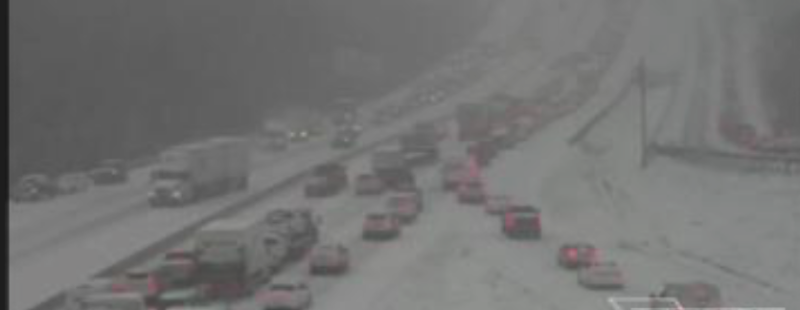
Crisis communication lessons for government agencies were on full display last week when Missouri’s Highway Department (MODOT) stumbled through a preventable media fiasco during St. Louis’ surprisingly disruptive early-arriving snowstorm.
As little kids we were all told at some point to “think before you speak.” Those of us in the world of communications and media relations have taken this admonishment from mom and dad and made it into a career!
When talking to the media, this not only applies to concerns about being offensive or rude, but also to being misunderstood, then getting hammered for it. Case and point: Last week’s “snowstorm” (I use the term loosely) that brought St. Louis to its knees and left the Missouri Department of Transportation (MODOT) trying to re-explain its explanation.
Here’s what happened: On December 1, St. Louis received an official total of 2.5 inches of snow. Some areas got up to 4 inches, but in a metro area in the Midwest, this amount of snowfall should fall into the “not a big deal” category. That is not what happened.
It all went sour because of a chain-rection of events. The forecast was somewhere between five and seven hours off as to when the snow would arrive. (It came in at 11am instead of the late afternoon/early evening storm that was predicted.) Everyone saw the snow start, panicked, and left work early. MODOT was unprepared for the early snowfall, and the plows were not rolling when everyone tried to scramble home. Next came the crashes. Then came the traffic jams.
Then there was the huge blunder by the agency, first saying the roads were not pre-treated for the snow (an inexcusable failure if true) then turning around and changing their story 24 hours later. (Which looked like they were lying whether they were or not) The result of it all was commutes of one to three hours in a town where you can normally be anywhere in 20 minutes and calls for government investigation into the agency.
MODOT called a news conference in the middle of the storm and made a bad situation worse. Crisis Communications 101. This is what KSDK-TV reported as their response:
 “Our expectation was that this was coming in at 4 o’clock this afternoon,” MoDOT St. Louis District Maintenance Engineer Bob Becker told reporters at a 1 p.m. news conference, about an hour and a half after snow began falling throughout the area. “If we would have known it was going to come in at noon, we would have had them first thing this morning. They would have been out hitting things. So, as this evolved this morning, we got them out as soon as we could. We can always wish that we would have got them out earlier. The storm came in several hours sooner than expected.”
The explanation is somewhat reasonable if read in full context, but the headlines were essentially, “MODOT Leaves Roads Untreated,” and “MODOT Blames Forecast for Snarled Traffic.” They were either accused of inaction, or passing the buck. Not a good look, and one that now has state lawmakers searching for a way to legislate the problem away.
So, what could they have done differently?
First, you need to lead with an apology. You blew it! Say so. (More on that in a moment) Next, if you are going to use context, you better have it close to the top. Instead of beginning with “The weather caught us off guard,” start with what you are doing to solve the problem. My suggested talking points after an apology would have been:
- We have every person available on the road right now.
- We have more people coming in as we speak.
- Our full team, with over 200 plows, will be out soon.
Only after speaking of the action you are taking do you get into the forecast issues. And when you do it, don’t make it sound like you are finger pointing. After that, make the issue relatable.
- Our anticipation of the storm arriving later had us scheduling people to come in late and work all night.
- The sudden change in the storm has us essentially changing over a hundred work schedules “on the fly.” Our people are moving as quickly as they can to get out there, but many are coming from home and are stuck in traffic, too.
Then there was also the very severe issue of MODOT not having its own facts straight. As mentioned above, in his initial statement to reporters, engineer Bob Becker said the roads had not been “pre-treated.” Hours later, that message changed completely. This was part of KTVI-TV’s coverage:
“By Tuesday, the agency adjusted its message, saying crews had treated the roads over the weekend.
 “District Engineer Tom Blair released a statement saying in part, drivers ‘tried to beat the afternoon storm onset by hitting the road around mid-day,’ adding that ‘the amount of traffic and incidents with the onset of the winter storm compounded the travel times and congestion.’”
So, first you didn’t pre-treat and then you did. It was the meteorologists’ fault. It was the community’s fault for leaving work all at once during a snow event.
Blame, excuses, bad information, then more blame. This was a total mess.
This is where an old strategy would have served MODOT well. “Mess up, ‘fess up, and then dress up.”
Clearly mistakes were made. There were some forecasts that in fact did have the storm coming in earlier. MODOT was not well prepared. So now that you’ve messed up, “’fess up.”
The first words out of their mouths should have been something to the effect of, “This is obviously an unacceptable situation. We are incredibly sorry for the inconvenience it is causing and are doing everything possible to get the highways in order.”
After you apologize and take accountability, tell people what you are doing to solve the problem. Then you can get into causes, being careful not to look like you are pointing fingers and making excuses.
Finally, and most importantly, have your facts straight. The biggest beating they took in this was for something the later said they actually did: pre-treating the highways. If that truly happened, that needed to be part of the list of proactive steps that were taken which, in this circumstance, were not working.
If it didn’t happen, be transparent. Tell us your thinking on the “why.” Were you waiting because the chemicals work better right before the storm? A reason like that makes sense. The problem here is when you change your story, it looks like you are lying even if you are not. That’s why having the facts straight is so important. If they had to wait an extra fifteen minutes to start a press briefing so they could gather the correct information, it would have been worth it, don’t you think?
No amount of talking points were going to make a person who sat in their car for three hours that Monday feel much better. It was frustrating. But transparency and media availability in situations like this almost always makes things a little bit better. Here, they made it worse. Why?
It was worse because the people in charge of the message didn’t take the necessary time to think that message through. They simply went in front of reporters unprepared, had their information wrong, played the blame game, and didn’t lead the whole thing with an apology. All things that could have been avoided with a little more preparation, and taking a moment to think back to what mom and dad always told you: Think before you speak.
George Sells is the Director of Client Services and Content for Chemistry PR and Multimedia. He also spent many years as a reporter, so he’s been on both sides of these things. Chemistry PR & Multimedia specializes in crisis communications.